22 May 2012

who doesn't love puppies?

scotties towel

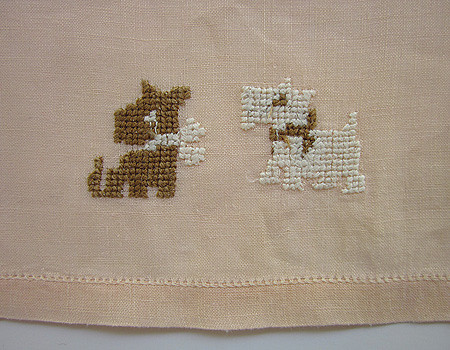
I found this sweet peach-colored linen towel recently at an antique mall. The bottom edge features two dogs (Scotties, maybe) embroidered in brown and white using very small cross stitches—almost, but not quite, petit point.

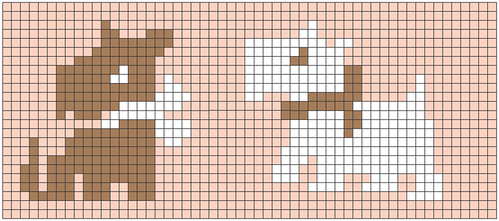
You can probably figure out the design yourself—it's pretty simple—but I made it into a charted pattern for you. Click through to the Flickr page for a larger version.

scotty_puppies

19 May 2012

alternate (or double) stem stitch

One of my readers emailed me to ask about a stitch called double stem stitch. And I checked all my embroidery books and didn't come up with anything. But many stitches are called by different names depending on where they originated and are used, so I think I may have found it but named alternate stem stitch. Feel free to correct me if I'm wrong.

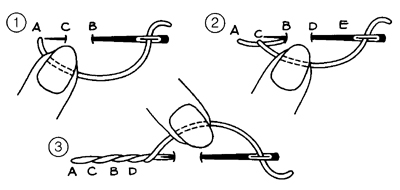
So, as a quick refresher, stem and outline stitches are done the same way except that stem stitch holds the thread below the needle (diagrams 1 and 2) and outline above (3). Alternate stem stitch is going to use both of these methods combined.


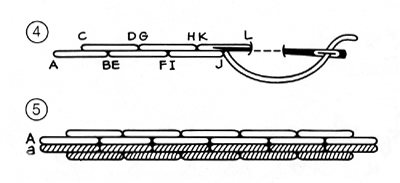
Work along a line as for stem stitch but, instead of holding the thread below the needle for every stitch, hold it alternately below for the first stitch (ABC), above for the second (CDB), below for the third (EGF) and so on. See the first diagram (4).


The second diagram (5) shows what happens when you work two rows closely together. Start the second row at "a", holding the thread above for the first stitch, below for the second, etc.

Diagrams from Stitches with Variations: A Handbook of Basic Stitches by Jacqueline Enthoven. ©1976 Sunset Designs. Many thanks to Patricia in NJ (my 'personal shopper') for sending me the book!

10 September 2011

floral monograms

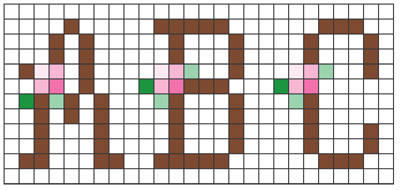
small floral monograms
I found a very old embroidery booklet at an antique mall during the summer—Alphabets and Monograms by Anne Orr. Sixteen pages of designs, some of which have floral details like the one shown here. I've been redoing the designs into modern charts with the hope of reproducing the booklet. Not quite ready yet but I thought I'd share one of the designs with you.

I'm slightly embarrassed that I haven't posted anything since April - yikes! But I've been so busy with my business this summer that I haven't had time to post. So, the free monogram chart is my way of making it up to you (click through the small chart detail above to my Flickr page where you'll find a large size chart of the entire alphabet). Enjoy!

29 April 2011

an easy (really) crochet edging

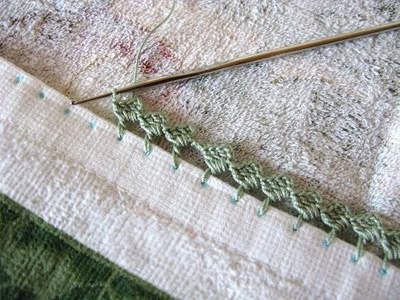
crochet_closeup
I have several stamped-for-embroidery pillowcases that already have the holes along the edge for attaching crochet. I just never knew how to go about attaching it. Well, I sort of knew but, having never crocheted before and finding most instructions daunting, I've never even tried.

But, there may be hope for me yet. Kathleen Mower, on her blog Miss Abigail's Hope Chest, has a tutorial for an easy zig-zag crocheted edging that might be the perfect thing to finish my project. Perhaps yours, too. She added hers to a towel (and it took just 30 minutes!), but it should work equally well for pillowcases. If you want to try this, she suggests skipping over some of the holes, choosing ones that are spaced about 3/8-inch apart; otherwise there won't be enough room for the little diamond shapes.

10 April 2011

Book Review: Embroidered Flora & Fauna

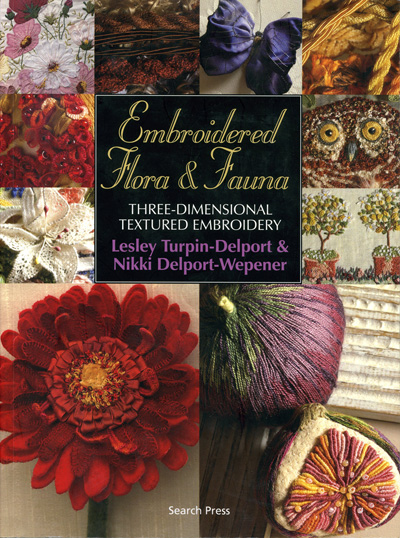
Embroidered Flora & Fauna

This lovely book was first published in 2007 in South Africa, again in Great Britain in 2008, and reprinted twice more in 2009. Which tells you something of it's popularity with lovers of needlework. And the projects are simply stunning. You'll get plenty of basics as to techniques and materials, too, but it's probably not for the beginning embroiderer. Think of it as a next step when you feel the need to add some dimension and texture to your work.

000379And three-dimension and texture are what this book is all about. Techniques include fabric manipulation, wire-edged applique, barbola (unwired stumpwork), needle lace on wire, trapunto quilting, working with felt and ribbon, beading, and metallic threads. Used together as mixed media, which you'll see in the projects that follow, they provide endless ways of creating realistic flora and fauna.

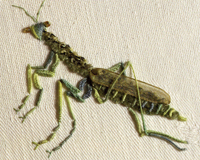
The projects, which are all inspired by the natural world, are categorized by color inspiration. Red, for example, features projects for three-dimensional felt gerbera daisies and wired applique bougainvilla; green has a nesting weaver bird incorporating actual feathers and a praying mantis that uses organza ribbon for his transparent wing. There are flowers, butterflies, insects, and birds and even a project for a realistic fig made from felt, yarn and beads (see the book cover for a close-up of this). All projects are illustrated with gorgeous photos of the finished piece and many have close-up views as well so you can really see the fine detail.

The book finishes with a section of black-and-white stitch diagrams and patterns for the projects that require them.

I found my copy at my local fabric store but it's also available on Amazon (and if you want to purchase a copy, please click through the link included above).

20 October 2010

embroidering on gingham

Gingham can be a great fabric to embroider on, and not just for working chicken scratch. It's already got a perfectly square grid so any patterns designed for cross stitch will work equally well on it. Use the corners of each small square (or skip over a few if the squares are very small) for your needle entry and exit holes.

rooster aprons

I found these two aprons recently at an antique mall—one pink gingham, the other yellow. Both have a row of brown and red chickens along the bottom. I'm including the pattern here — it's been a while since we've had a freebie! Enjoy!

Roosters
Click the pattern image for a larger version.

19 October 2010

redesign

Cross stitch sometimes gets a bad rap, especially here in the U.S., with the predominance of cutesy kits in craft stores and overly sweet projects in magazines. There's the exception to be sure, but in general, I haven't been impressed with what I've seen.

So, I was happy to be asked to review the redesign of Cross Stitcher magazine. My big concern, since this is a British magazine, was whether we could buy it here in the U.S. They assured me that it's available in some Borders stores (although, sadly, not in mine) and also by subscription for £79.99. Or you can purchase digital editions— single issues for £6.70 and a 13-issue subscription for £60. But, with the exchange rate currently not in our favor, the best deal is at Magazine Nook for $23.39 with free shipping. If you're located in the UK, of course, you shouldn't have problems finding it on the newsstand. The redesign debuts with the current issue (Issue 232 November 2010).

CrossStitcher Magazine

I'm still awaiting my printed issue to arrive by mail but I got a chance to preview an online sample. I'm impressed, both with the colorful and fun design of the magazine and with the projects. The magazine opens with a free chart for embroidering gingham heart sachets (each issue includes a free project pattern). Following are lots more fun projects—like felt baby booties (so cute), a realistic Jack Russell cushion, covered buttons, the ever-popular owls, and designs for Christmas cards. Every issue has a section called The Savvy Stitcher—this time it features applique, using Bondaweb, stitching basics, and alphabet charts for personalizing your projects.

Savvy Stitcher

Be sure to visit their website, sign up to receive their newsletter, and become a fan on Facebook. They offer lots of freebies on all of these and a chance to interact with other readers and stitching fans.